Showing posts with label populism. Show all posts

Sunday, October 27, 2019

Bernie Sanders, "political revolution," and corporate Democrats

The PBS Newshour interviewed Bernie Sanders last week: Spending ‘a lot’ on Medicare for All will save people ‘substantial’ money 10/21/2019:


Sanders explicitly describes what he means by wanting a "political revolution." This will be helpful to remember when the corporate Democrats and the Republicans roll out the stock accusations that Sanders wants to guillotine everybody in sight, and other things along that line. From the transcript:
I think that the only way we bring about real change in this country is not within Capitol Hill. What I believe is, we need a political revolution, like the labor movement did in the '30s, like the women's movement, the civil rights movement, the gay movement.

Millions of people have got to stand up and fight for justice. So what our campaign is about is twofold. Number one, I do believe I'm the strongest candidate to beat the worst president in the history of this country, the most dangerous president, Donald Trump.

But ... what I know is that no president, not Bernie Sanders or anybody else, can do it alone.

So, what this campaign is about, it's not just winning the election. It is about building a movement of millions of people who, in fact, will stand up to the greed and corruption of the fossil fuel industry, the drug companies, the insurance companies, the military industrial complex, et cetera.

That is the only way that I know as to how we can bring about real change. We are the only campaign, I think, who goes going forward in that direction. [my emphasis]
To be fair to the corporate Democrats, they and their big donors do oppose the kind of democratic and anti-corporte movement Sanders describes there.

So while their demagoguery against Sanders may be malicious and dishonest, they do understand what his popular programs is and they do oppose it.

That quote is also a good illustration of drawing the populist dichotomy of the People versus the Elite. Sanders' version is left populism, of course.

Tuesday, April 16, 2019

Confederate "Heritage" Month 2019, April 16: Slavery and the American Revolution

Historian Sean Wilentz, who has what I take to be a nuanced and sophisticated view of early American and antebellum history, did a review essay last year on Harvard historian Jill Lepore's These Truths: A History of the United States (2018). (The American Revolutions New York Review of Books 11/08/2018)

I've been referring in the last few posts in this series to the conflicting trends we see in American history, such as that between democracy and white supremacy, or between the rule of law and authoritarianism. Wilentz describes three major narratives about slavery in the early decades of the United States as a country:
One well-established line of argument holds that the Revolution unleashed what Bernard Bailyn once called a “contagion of liberty” that eventually challenged the enormity of slavery. Another line is tougher on the Revolution’s hypocrisy, echoing Samuel Johnson’s famous jibe about hearing “the loudest yelps for liberty among the drivers of Negroes.” A still-darker argument asserts that slavery was a cornerstone of the Revolution’s republicanism - that slaveholding aristocratic rebels like Washington, Jefferson, and Madison could, as Edmund Morgan wrote, “more safely preach equality in a slave society than in a free one,” and that they accordingly promoted a racist republicanism that kept poorer whites contented by the fact that they were not black and not enslaved. [my emphasis]
All of those positions are based on real factors. I have a sentimental attachment to the “contagion of liberty” perspective. I try to maintain a critical perspective on my own outlook by paying attention to the Samuel Johnson take, which is based on the very obvious historical reality that slavery and white racism were deeply rooted in the early Republic. As one might guess from the name of this blog, I'm enough of a Hegelian to not be surprised at big contradictions in a country's historial process.

I pay attention to the third perspective. But it still looks to me like a basically reactionary position and ignores some important changes in the institution of slavery itself during the early years of the US, such as the invention of the cotton gin. I don't see how that view is compatable with things like the (pre-Constitution) Northwest Ordnance that banned slavery in northern territories. Or with the voluntary abolition of slavery in various northern states.

Wilentz writes that Jill Lapore "advances an emerging view among historians that there were two eighteenth-century revolutions in America, not one: the familiar successful rebellion against monarchical rule and a less remembered one to abolish slavery that would not succeed until 1865." I'm not sure if he means to differentiate that approach from the "contagion of liberty" outlook, because it seems to be consistent with that view. Also, since a large portion of the left and center-left seem to have written off much of early and antebellum American history as a long, dark night of slavery and reaction, I'm not sure that in popular understanding of history that the Civil War is "less remembered" that the Revolution. I would agree that the Civil War can and should be understood as a second revolution, although in very meaningful ways it was an extension of the first one. Which would be consistent with the "conagion of liberty" perspective, much less so with the slavery-as-a-cornerstone outlook.

Wilentz also makes this important observation about the evolution of the parties on the slavery issue. Note that the party he calls Republican in 1819-20, consistent with the contempory usage, was the Democratic-Republican Party founded by Thomas Jefferson, which was commonly referred to as the Republican Party until later in the 1820s, when it became known as the Democratic Party, of which today's Democratic Party is the same organization. The present-day Republican Party was founded in 1854 as an anti-slavery party.
Federalists and Jeffersonian Republicans did not ... align as, respectively, antislavery and proslavery parties prior to the momentous crisis over the admission of Missouri as a slave state in 1819 and 1820; most congressmen in what John Quincy Adams called the “free party” were in fact northern Republicans. Adams, who was by then a Republican himself, did become increasingly opposed to slavery over the following decades, as Lepore relates, but partly on that account, he never “steered the erratic course of the Whig Party,” as the book contends. If he had, something like Lincoln’s Republican Party might have arisen two decades earlier than it did.
Much of Wilentz' essay is devoted to an evaluation of Lapore's analysis of the Populist tradition in US politics. He links that back to pre-Civil War days and the Calhounian trend that on which I've been focusing in several posts in this year's "Heritage" series:
Trump may perhaps reflect the worst in the long history that Lepore relates, but in more ways than she suggests, he also represents a sharp break, matched in our history only by Southern secession and the Civil War. Reclaiming America’s truths means, first and foremost, understanding the exact historic dimensions of the unprecedented crisis—a crisis that, beyond demagogy, lies, and phony populism, goes to the legitimacy of the constitutional order. [my emphasis]

Thursday, December 13, 2018

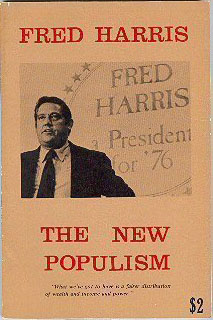
Fred Harris on left populism, 2018

Former Democratic Sen. Fred Harris, who just turned 88 last month, did this interview with Marc Steiner in March of this year, Sen. Fred Harris: The Last Surviving Member of the 1968 Kerner Commission 03/06/2018.

Fred ran for the Democratic nomination for President twice, once in 1972 and also in 1976. Marc Steiner mentions in the interview that he did some work for him on the 1976 campaign. So did I. I was on his camapaign staff for a few months.

His campaign and his ideas then had a big effect on my political thinking, and still do. And he's still on the same broad wavelength in this interview, explaining what left populism is, though without using that exact term, "left populism." He used "The New Populism" as his theme in 1976.

He praises the Rev. William Barber's and his Moral Mondays movement, with which he clearly identifies. He repeats something he was saying in 1976, too: "I always say that people in our coalition, this majority coalition, they don't have to love each other. I wish they would. But all they have to do is to see that their interests are in common."

That's left populism in a nutshell.

Friday, November 2, 2018

A win for EU law and democracy in Poland

Wolfgang Münchau's Eurointelligence Professional Briefing (Public Section) 10/31/2018 has an optimistic take on Poland's response to an important ruling by the European Court of Justice (EJC) in A further move in Warsaw to submit to the ECJ’s authority (scroll down).

The case in question had to do with a move made by Poland's authoritarian government to undermine the judicial independence of the Polish Supreme Court. As Jon Stone reports (European Court of Justice orders Poland to stop purging its supreme court judges Independence 10/19/2018):
Since coming to power in 2015, Poland’s right-wing populist Law and Justice governing party has pushed through a series of controversial changes to judicial appointments that critics say put too much power in the hands of the government and endangers the independence of the judiciary.

The numerous changes give the governing majority in parliament greater power over judicial appointments, while another new law also forced around a third of the country’s supreme court judges into retirement earlier this year.
This was a critical step by the Polish government in departing from the minimal standards of democracy required by the European Union for member states. Both Poland and Hungary are currently under "Article 7" investigations for such violations of EU democratic standards, the actions against the Supreme Court being the most pressing concern in Poland's case. (Maïa de la Baume and Dvid Herszenhorn, EU unpersuaded by Poland’s defense at rule-of-law hearing Politico EU 06/27/18)

The ECJ ruled that the changes violated European law. And the Polish government has agreed to abide by the ruling for now. The judges the government forced into retirement are now back and work and recruitment for their replacements has been halted.

A previous Eurointelligence briefing (Poland's local elections reveal deeply-split country 10/25/2018) noted:
The government in Warsaw continued as in the past to respond with mixed signals, saying on the one hand that it would respect EU law – and therefore the ECJ’s injunction - while trying to get Poland’s supreme court to invalidate the ECJ's ruling. Its argument is that the Polish constitution supersedes the ECJ's treaty-based powers in this case. We note that this dispute is not specific to Poland: the conflict about the primacy - or not - of the national constitution over EU treaties has for instance been brought repeatedly before Germany’s supreme court. The judges in Karlsruhe judges have until now responded with deliberately ambiguous judgments, maintaining a prudent judicial truce, and evading a clear decision about its own possible subjection to the ECJ. Will the Polish judges risk a fundamental conflict their German peers have until now done everything to avoid? And, if yes, how will the EU respond? What is at stake here goes way beyond the preservation of fundamental norms in Poland. [my emphasis]
As the 10/31/2018 briefing puts it, the represents a win for "a common view of the proper order of things" within the EU:
What if this common view is no longer shared to a sufficient degree by political majorities in each member state of the EU? Three things can happen. States can choose to leave. Disintegration can occur from within. Or the common view becomes a common order imposed and successfully enforced from above in a classic process of state formation. It is the third response that is at work in the EU — forget all the analysis being written about how EU integration has come to a halt.

The EU’s nascent fight against dark money and corruption, the halt to Poland’s judicial reform – these are just two of the manifestations of European power expanding its reach and moving to assert control in important and unprecedented ways. Is it a struggle? Of course it is. An easy one? Of course not. But it is a sign of the EU responding to challenges of a kind that were always going to be inevitable in a hugely expanded Union of 445 million inhabitants and 27 States, with more power rather than new weakness. [my emphasis]
Poland had regional elections last month, and the results were mixed. But they were certainly not a sweep for the rightwing populists.

The rigtwing populist Law and Justice Party (PiS, from the Polish initials) under its Chairman Jarosław Kaczyński is the dominant party at the national level. The 2018 regional elections were the first time in three years the PiS faced the voters' judgment. The results came out with 32% for the PiS and 44% for the two largest opposition groupings: Citizens Coalition with 27% and PSL (Polish Farmers Party) with 17%. (Clara Mode, Polen, wo bei einer Wahl alle Parteien gewinnen und keine verliert Standard 30.10.2018)

The current Polish President is Andrzej Duda of the PiS, elected in 2015. But Kaczyński is widely regarded as the power behind the throne.

The May 2019 EU elections are already getting a lot of attention. The rightwing populist parties In Europe have ironically used the EU Parliamentary elections as a way to build an anti-EU message and get recognition for their leaders. So hopefully the other parties will take the EU elections more seriously than in the past. And that seems to be happening at the moment. May will be a big milestone in current EU politics.

Ivan Krastev wrote earlier this year ("Eastern Europe's Illiberal Revolution" Foreign Affairs 97:3 May/June 2018):
Poland's government has also sought to dismantle checks and balances, especially through its changes to the constitutional court. In contrast to the Hungarian government, however, it is basically clean when it comes to corruption. Its policies are centered less on controlling the economy or creating a loyal middle class and more on the moral reeducation of the nation. The Polish government has tried to rewrite history, most notably through a recent law making it illegal to blame Poland for the Holocaust. [my emphasis]
He also notes that the rightwing populist regimes currently in power in Hungary and Poland display "a Janus-faced attitude toward the EU." That is, they bitch and moan about the EU. But they get a lot of money from the EU: "Poland is the continent's biggest recipient of money from the European Structural and Investment Funds, which promote economic development in the EU'S less developed countries."

This is at least analogous to the phenemenon we see in the US, where the Democratic states tend to be net contributors of federal revenue while Republican ones are net recipients, even though the Republicans actually want to reduce those transfers significantly.

See also:

Tuesday, October 16, 2018

What does a democracy under internal threat look like?

This week's Profil (15.10.2018) has a story, "Abrisshirne" by Martin Staudinger and Robert Treichler, that I found really irritating. Which in this case, turned out to be a good thing, because it made me concentrate on the points they are making.

The topic is whether there is a world trend toward similar populist-authoritarian movements and governments. The title pages feature phots of Rodrigo Dutere (Phillipines), Jair Bolsonaro (Brazil), Nicolás Maduro (Venezuela), Matteo Salvini (Interior Minister and de facto head of government in Italy), Viktor Orbán (Hungary), Hein-Christian Strache (Vice Chancellor of Austria and head of the far-right FPÖ), Donald Trump (of course!), Tayyip Erdoğan (Turkey), and Andrés Manuel López Obrador, aka, AMLO (President-elect of Mexcio).

Putting AMLO in that list is pretty silly. he won the Presidential election in July and takes office December 1. Why he was included in that particular group as part of the "Populist International," as the caption called them is a mystery. I didn't follow the campaign closely, but my impression is that it was more a conventional center-left campaign rather than distinctly populist. More importantly, he served for five years as Governor of Mexico City (Federal District of Mexico) and built a reputation as an good executive who fought corruption. How that makes him a Duterte or an Erdoğan, I have no idea. The only thing the article itself says about AMLO is that he's an "erratic populist." Erratic? Why? It's sloppy at best to lump him into this group.

Nicolás Maduro can legitimately be called a populist. But, to put it generously, the constant American polemics against Maduro and Hugo Chávez before him as dictators was always overblown. Prior to 2016, international observers of Venezuelan elections under both Chávez and Maduro, including the Carter Center, regarded their national elections as legitimate with strong safeguards against fraud. The US is openly engaged in a regime change effort against the current Venezuelan government and Trump has threaned to militarily invade the country. And the US government always become intensely concerned about human rights and democracy in countries that it is preparing to bomb and kill lots of their people. Also, not at all incidentally, Venezuela has the largest known oil reserves of any country in the world. Anyone who think that hasn't been the overriding concern of American policy toward Venezuela is disregarding the entire history of US dealings with Venezuela and the rest of Latin America. Venezuela is a petrostate heavily hit for years by falling oil prices and facing a protracted period of civil disorder that makes it particularly difficult to compare Venezuela's situation in 2018 with any of the other country's whose leaders feature in the Profil rouges' gallery.

But Staudinger and Treichler do ask their readers to think more closely about just what features of a government make it democratic versus not-so-democratic. For instance, they point to previous worries about apathy among voters in liberal democracies, and note that voter participation has been rising. Because of the interest generated by the far-right Alternative für Deutschland (AfD). Without diving into the voting numbers here, it's a valid point that needs to be considered when we look at the antidemocratic trends their article highlights.

Don't be superficial about it, in other words.

Unfortunately, the reader doesn't come out from reading the article with any real guidelines on how to go about making that judgment.

The EU has started a formal review of the status of democracy in the member states Poland and Hungary. The EU does have a variety of standards for a country to qualify for EU membership, including things like democratic elections, a stable rule of law including politically independent police and courts, recognition of basic civil liberties and human rights, equal voting rights for all citizens. The EU also has standards for business law and regulatory practices. Unfortunately, after the 2008 financial crisis, the EU was far more focused on enforcing bad neoliberal economic policies than they have so far shown about enforcing democratic standards on member states.

The very legitimate concerns that have been raised about Poland and Hungary have particularly to do with the independence of the judicial system and whether the election system has been rigged so that the ruling party in practice cannot be voted out of office. Freedom of the press is also a major concern in both countries.

Some of these considerations are region- and country-specific. For instance, in the United States, public television receives relatively little public money. And the major news outlets are also not publicly funded and are generally businesses and some nonprofits. Governmental actions clearly aimed at punishing or restricting the functioning of independent, i.e., non-govwernmental, news operations raise real concerns about inerference with press freedom. But the federal government deciding not to financially support public TV, while that may be a bad decision, would likely not significantly reduce news coverage of public affairs.

The situation in Europe is different. Publicly-funded news media, organizationally structured to be independent of day-to-day political interference, are a major source of public news. The BBC in Britain is generally seen as the model of this approach. Other such public news operations include ARD and ZDF in Germany and ORF in Austria. Drastically reducing their public funding or trying to turn them into partisan outlets would negatively affect the availability of professional, independent news available to citizens.

A different situation is presented by Latin American countries like Argentina in which news media is broadly in the hands of oligarchs and often present news with a strong partisan-political slant. In that situation, a center-left government that uses public media outlets for news and documentaries with a viewpoint friendly to, or at least not hostile to, the elected government couldn't be said in itself to suppress press freedom. Independent public news organizations on the BBC model would improve news coverage and expand freedom of the press in those situations.

A final observation on comparing far-right political movements is that looking at international connections and interactions between those groups and parties. Far-right parties in EU countries interact on an individual basis with one another. And there is an umbrella European party represented in the European Parliament that connects some of those parties in a more formal way. And Putin's Russia is actively encouraging the far-right populist parties in an effort to undermine the EU.

[01/24/2018: Updated for clarity.]