Wolfgang Münchau sees increased EU-US trade conflict even if Bunker Boy departs the White House in January. (
A truly ugly transatlantic trade war is looming Financial Times 06/21/2020)
One major topic in dispute is a digital tax that the EU wants to impose on US tech giants like Facebook and Google. Münchau supports this idea, which the Trump-pence Administration opposes:
I think EU countries are right to press ahead with a digital tax. The digital economy is one of the few sectors to have performed well during the pandemic. There is no reason why this profitable sector should not pay its fair share.
Tax avoidance by large companies has also become a big political issue in France, Germany and the UK. Emmanuel Macron would endanger his chances of remaining president in 2022 if he caved in to the interest of US tech giants. London is also planning a digital tax — another obstacle to a UK-US trade deal. Robert Lighthizer, the US trade representative, said last week that the US would not agree to a UK deal without market access for US goods — the infamous chlorinated chicken. But the US position on digital tax is unreasonable. [my emphasis]
Mark Scott et al report for Politico EU on the dispute over the digital tax proposal,
Threat of EU-US trade war grows amid digital tax stand-off 06/19/20:
At stake is which country has the right to tax digital companies whose operations now span the world. The looming spat also may sour an already tense relationship between the U.S. and EU at a time of deepening wariness, while also potentially exposing divisions within Europe as countries remain split over how to force companies like Google and Amazon to pay more into national coffers. ...
Over the past year, governments in France, Italy and the United Kingdom have all passed digital tax rules that aim to collect hundreds of millions in revenue from tech giants, many of them U.S.-based companies with big operations in Europe. [my emphasis]
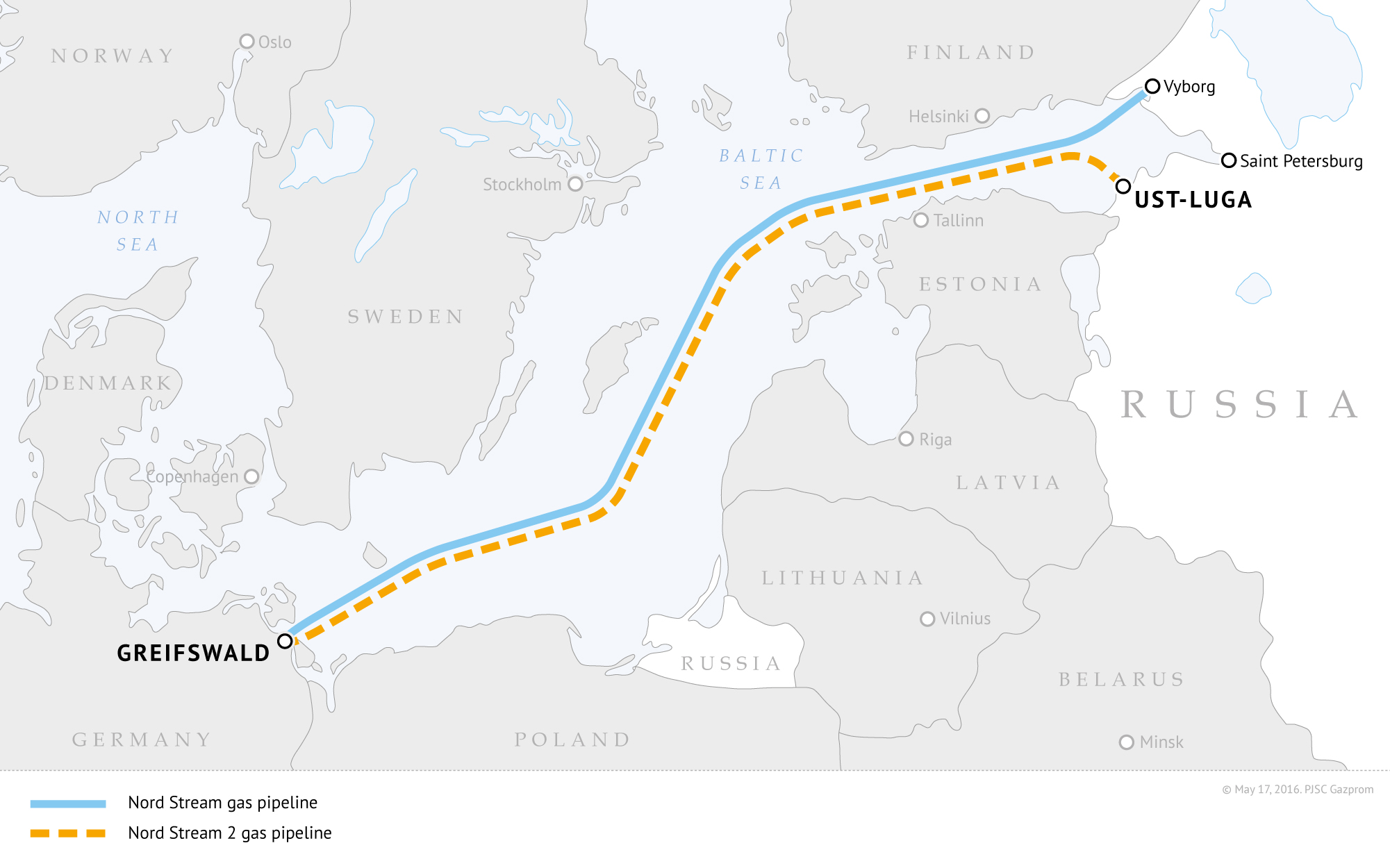
Another major issue is the US opposition to the Nord Stream 2 oil pipeline project with the Russian company Gazprom. This map from
Gazprom's current English-language website on the project shows its planned route:
Münchau calls Nord Stream 2 "a sordid gas pipeline deal," though in his column it's not entirely clear what he finds sordid about it. The US opposes it for a variety of reasons, including its potential to increase European dependence of Russian oil and therefore makes the EU more vulnerable to Russian pressure by withholding oil, as Russia has done with Ukraine. The US also has outstanding disputes with Russia over Ukraine and election interference, in particular.
Germany views it as a profitable project for German firms and a contribution to energy stability, which is a major feature of EU energy policy. There are objections from environmental groups to the project. And eastern European countries, notably including Poland, are also opposed to it because of fear of increased Russian influence. On the other hand, it is also a fundamental idea of the EU that increased economic ties promote peace and make war less likely. Russia's economy is still heavily dependent on oil exports, as it has been since the 1970s under the Soviet Union. So Russia sees both profit and potential political clout in the deal.
Kirsten Westphal in the German energy-industry journal
e.m.w Energie.Markt.Wettbewerb Oct 2016 describes the geopolitical considerations for the EU as follows (my translation from the German):
Nord Stream 2 and the future of Ukrainian transit [of oil] are symbolically highly charged in the political debate. Not only does it make it difficult to work on their policies, it is also driving EU energy policy in a difficult, if not dangerous, direction.
The dispute over Nord Stream 2 reveals dilemmas and discrepancies in the EU: In the EU-28, there is a general debate about how the future with Russia - including in energy relations - should be shaped. This is also true of the trilateral relations with Russia and Ukraine. Above all, however, there is disagreement among the EU-28 as to the shape of the [European] Energy Union and the Union's climate policy. This applies not only to the ambitions and objectives of climate protection, decarbonization and energy efficiency, as well as burden-sharing. The consensus on principles and guiding models seems increasingly fragile as some [EU] Member States are moving from a liberal energy market model to a state-interventionist, mercantilist energy policy. This increases political uncertainties and legal uncertainties. A reversion to a reliable legal framework, competition and the further development of the internal market are needed.
Münchau warns that Europeans should not assume that transatlantic trade relations will necessarily improve under a Democratic administration:
Europeans tend to associate the deterioration in the bilateral US-EU relationship with Mr Trump personally. But whatever tariffs, duties or sanctions Mr Trump might impose on Europe, most are likely to survive even if he is not re-elected. And, if he does remain in the White House, it is reasonable to expect the relationship to deteriorate further. So no matter what happens, the damage to the transatlantic alliance will persist.
If the pandemic had been a truly symmetric global shock, the story of deteriorating trade relations might have taken another turn. Countries would have had a greater incentive to align their policies. But the US may well come out of the slump faster than the EU — just as it did after the global financial crisis. Despite a higher number of cases and coronavirus-related deaths, it has a more robust economy and is less dependent on global supply chains than Europe. [my emphasis]