The Biden-Harris Administration reached an understanding with Germany to drop US sanctions against the Nord Stream 2 project, Germany, US strike Nord Stream 2 compromise dealDeutsche Welle 07/22/2021:
That DW report suggests plausibly (though not precisely in these terms) that Biden's position has to do with balancing together with the EU and Russia against China. From an American or EU viewpoint, whether Nord Stream 2 is helpful or detrimental geopolitically depends on how it fits into the much larger network of relationships among the US, EU, Russia, and China.
DW also notes that the German Green Party is cool toward the Nord Stream 2 project, partially on environmental grouods but also because they want a less friendly policy toward Russia. The Greens' foreign policy has long since ceased to be the "pacifist" policy it once was. They are now more focused on showing they are "tough" and "pragmatic".
Wolfgang Münchau of Eurointelligence calls Nord Stream 2 "a sordid gas pipeline deal," though in a 2020 column I previously cited it's not entirely clear what he finds "sordid" about it. The US had previously opposed it for several reasons, including its potential to increase European dependence of Russian oil and therefore make the EU more vulnerable to Russian pressure by withholding oil, as Russia has done with Ukraine. And obviously there are a number of outstanding disputes over particular problems between the US and Russia, including Russia's annexation of Ukraine's territory in Crimea and Russian and Russian interference in US elections.
Germany has seen Nord Stream 2 as a profitable project for German firms and a contribution to energy stability, which is a major feature of EU energy policy. There are objections from environmental groups to the project. And eastern European countries, notably including Poland, are also opposed to it because of fear of increased Russian influence.
But with this project, influence and dependence go both ways. It is also a fundamental idea of the EU and Germany in particular that increased economic ties promote peace and make war less likely. Russia's is a petrostate, its economy still heavily dependent on oil exports, as it has been since the 1970s under the Soviet Union. So Russia sees both profit and potential political clout in the deal.
Again, how heavily the influence leans on one side or the other depends heavily on the broader course of EU-Russia relations. Is it necessary to add that the Trump-Pence Administration's stalling of the project did not seem to take much concern for the4 complexities of that larger picture? Trump hated Merkel, and his own considerations may not have gone much beyond that.
Wolfgang Münchau seems to be convinced that the Nord Stream 2 project is about the worst thing in the world. Or at least in Eueope. In his Eurointelligencepublic post of June 1 and May 28 ("Crisis in Russian-German relations"), he makes it sound like the Nord Stream 2 project is something like a completey complete capitulation of German sovereignty to Vladimir Putin.
In today's article, Münchau refers to three German NGOs operating in Russia that were banned, organizations that probably very few EU citizens have ever heard of:
The three NGOs are the Center for Liberal Modernity, the German Russian Exchange, and the much smaller Forum of Russian-Speaking Europeans. Russia banned them over undesirable activities that violate Russian interests. Russia accuses the organisations of justifying terrorist activities and of resisting Russian energy projects, including Nord Stream 2.
I would assume - knowing virtually nothing about the specifics - that the charge of "justifying terrorist activities" is mostly bogus, if only because it doesn't fit with the other charge. If an NGO is trying to lobby against the Nord Stream 2 project in Russia, why would it risk its credibility by "justifying terrorist activities"?
This is another reminder that international relations operate on a continuum from those activities formally considered totally legitimate to those that are cynical and illegal. And intelligence agencies will operate to gather information and promote national policy ends across that whole spectrum. It's very hard for citizens and news consumers to make an isolated judgment in cases like this where these three little-known NGOs are banned without a great deal more information about the context.
But Münchau seems to think this is all part a larger failure of German foreign policy testosterone in relations with Russia:
In this context we noted a comment by the British journalist Will Hutton who made the observation that the dictators are winning against the democrats. We agree with his observation, but disagree with the reasons. It is not because the west was not living according to its values, as Hutton argues, but because the west is willing to do dirty deals with the dictators for short-term gains, and not stand up to them. The ban of the three German NGOs is the best example of what happens if you don't. [my emphasis]
Here is some additional information about the NGOS in question.
Center for Liberal Modernity (Das Progressive Zentrum website):
The Center for Liberal Modernity is a German think tank that was founded by the Green politicians Marieluise Beck and Ralf Fücks in 2017. LibMod is aimed to be a rallying point for free thinkers from different political camps, finding answers to the challenges of our time and promoting the formation of political thought in that spirit.
Our by far biggest German-Russian project is “Climate change and economic modernization of Russia”, which comprises numerous experts from both countries. In addition, we are running a German-Russian dialogue project about the importance of Andrei Sakharov. We also host the website www.russlandverstehen.eu and the annual international conference “Russia and the West”. Our Russia-related activities are partially funded by the German Foreign Ministry.
We never disguised our critical position versus the Putin-Regime which made us focus on cooperation with Russian civil society and engaging in the debate about adequate policies vis a vis Russia in both Germany and the EU. Our dream (for the future) is a democratic and European Russia.
During all years of its existence, the DRA has provided tens of thousands of people with additional expertise and intercultural experience through specialist and educational programs, volunteer stays, resource centers and projects to overcome conflict. In addition, our work has made possible personal contacts that have shaped the lives of those involved for many years or even forever. By co-founding and developing important international platforms, the DRA has brought civil societies in many countries closer together. Finally, for years the organization has been a member of the Petersburg Dialogue which promotes cooperation between civil societies in Germany and Russia.
Deutsche Welle reports (German-Russian Petersburg Dialogue forum in jeopardy over NGO ban 05/28/2021): "The Forum of Russian-Speaking Europeans, meanwhile, was founded in 2017 by a Berlin-based Russian exile. The organization describes itself as a network of actors 'subscribing to liberal-democratic values, who oppose Putin's dictatorship, aggression and propaganda.' The NGO stages anti-Kremlin protest events." (my emphasis)
That's good news as far as it goes. Notably, the EU was caught flat-footed by Biden's announcement. But the EU is not nearly as far along with the domestic vaccinations as the US is at the moment: Ashley Furlong, US shift on vaccines embarrasses Europe before India summitPolitico EU 05/06/2021:
The U.S. decision to drop its objections was received as a seismic shift in Europe, with EU and U.K. officials scrambling Thursday morning to react and articulate whether they, too, would shift their position. And within the EU, cracks in the bloc's solidarity against the proposal started to form, with Italian officials expressing support for the patent waiver. [my emphasis]
The diplomat also reiterated U.S. President Joe Biden’s personal opposition to the Nord Stream 2 gas pipeline project linking Russia and Germany. Despite the U.S. Justice Department initially deciding to allow sanctions against the company building the gas pipeline as part of new penalties against Russia, the approval was reversed in April. However, the U.S. president still believes Nord Stream 2 is “a bad idea,” Blinken said. [my emphasis]
I could really do without all the "new Cold War" talk, although that talk is more centered on China than Russia. But the Nord Stream 2 pipeline is a big negotiating point, which could turn out to be constructive or seriously problematic, depending on how it is actually fitted into the larger picture of US-Russia-China relations. It increases European dependence on Russian gas. But Russia is a petrostate, so it also makes Russia more dependent on Europe.
So it's a relief to see this bit of pragmatism in US foreign policy. It makes total sense to keep Nord Stream 2 as a negotiating point in a larger set of relationships. Which I'm pretty sure is not exactly how it was being approached by the US the last couple of years.
Fred Kaplan seems to have been more disturbed than impressed by Secretary of State Tony Blinken's confrontation with Chinese diplomats in Alaska last week. (A Cold Welcome in AlaskaSlate 03/19/2021.
Noting that Blinken had "all but said in advance" that the meeting would go badly" - i.e., it was a pre-planned moment of verbal confrontation - Kaplan still writes, "It is surprising, though, that the meeting went so badly, and even more surprising that Blinken and National Security Adviser Jake Sullivan, who led the U.S. delegation, seemed surprised that it did."
He also notes that:
... after the reporters and cameras left the room. A “senior official” said Thursday night, that, after the stormy public ripostes, the two sides “got down to business” and held “substantive, serious, and direct” discussions that went “well beyond the two hours we had allotted.” This language—“substantive, serious, and direct”—is reminiscent of the term “frank and businesslike” invoked by public-affairs officials in the Cold War era to describe particularly tense meetings between U.S. and Soviet diplomats.
Kaplan also explains some of the leading considerations in balancing relations with other countries in the US-China relationship:
In this respect, the Biden team’s Asian voyage has been a mixed bag so far. Leaders of Japan, South Korea, and India have seemed pleased to be treated to the new administration’s first foreign trip, but it has highlighted conflicting interests as well as common ones. The joint statement released after Blinken’s meeting in Seoul, for instance, said nothing about “denuclearization of North Korea”—Biden’s security objective in the region—or about China. South Korean President Moon Jae-in avidly wants a peace deal with the North and, to that end, wants to avoid—much less join an alliance built on—confrontation with Beijing.
When Blinken goes to Europe next week for the annual meeting of NATO ministers, he will find that several allies there—notably Germany and France—want no part of what they see as a “cold war” with China, either. They rely on China for trade, don’t view the distant Pacific as a theater for national-security concerns, and so don’t view China as any sort of threat. [my emphasis]
As I say here periodically, I have a love-hate relationship with the "realist" view of international relations. It focuses on nations as actors in a state system which pursue a variety of interests that are often persistent no matter how domestic political ideologies may change in the national government. Some of the most perceptive critics of the Iraq War were noted advocates of the "realist" perspective like Stephen Walt who pointed out the unrealistic assumptions of the neoconservative warhawks and their fantasies of local populations jubilantly welcoming American troops conducting "wars of liberation". On the other hand, "realists" like Henry Kissinger have been known to conduct foreign policy with a level of cynicism that are difficult to justify in terms of real American interests, e.g., the 1973 coup in Chile. And even a common definition of what a country's most important interests are doesn't in itself produce agreement on how to conduct foreign policy.
But one central realist concept has been understandably prominent in discussions of China. Realists understand that when a major power like the US is declining in its relative influence that other powers will assert their own perceived interests more affirmatively. And in the case of China, which is becoming the largest economy in the world, the US and other countries, notably including Russia and the European Union, have to adjust their approaches and recognize the opportunities and dangers that can arise from that process.
So the dynamics of the US, Russia, and the EU in adjusting to the rising power and status of China will be a consistent theme is international politics for quite a while. Kaplan himself also argues that the US should avoid a "New Cold War" framework in our approach to China. (The U.S. Can Compete With China Without Fighting a “New Cold War”Slate 03/18/2021)
And because of those larger sets of relationships, individual issues like the Nord Stream 2 pipeline project, the Trans Pacific Partnership (TPP) neoliberal deregulation "trade" treaty, or China's Belt and Road Initiative (BRI; New Silk Road project) will be influenced in significant ways by the larger patterns of adjustments.
One notable development that doesn't seem to be registering very strongly with mainstream political analysts is that Russia and China have relatively good relations at the moment. Charles writes about this dynamic in Ziegler "A Sino-Russo Entente?" (The National Interest Mar/Apr 2021), online title A Russian-Chinese Partnership Against America? 03/06/2021, where he writes:
Each regime is acting as a pragmatic, nationalist great power, and each sees its interests as far more compatible with the other power than with the United States.
Russian and Chinese adherence to global rules is selective and cynical, though international law and institutions can be manipulated to frustrate American foreign policy goals. The two often vote together in the United Nations, for example, using their veto to counter U.S. and European Security Council resolutions on Syria. In 2018, Russian and Chinese diplomats discussed coordinating on the Middle East and agreed to maintain a dialogue on a range of issues in the region. The Middle East presents opportunities and security concerns for Russia and China as the United States disengages. Both opposed Donald Trump’s withdrawal from the Joint Comprehensive Plan of Action and have taken advantage of the situation by negotiating closer military and economic cooperation with Tehran. More broadly in the Middle East, China became the region’s largest investor in 2016, and in the following year established its first overseas base in Djibouti. Russia is engaged diplomatically across the region; is selling weapons to Egypt, Iraq, Saudi Arabia, Libya, the UAE, and Turkey; and recently concluded a twenty-five-year agreement for a naval base in Sudan to complement its base at Tartus, in Syria.
In other regions, the two countries may not be cooperating openly, but their implied support for each other’s aggression narrows Washington’s policy options. [my emphasis]
Wolfgang Münchau's Eurointelligence reports in Are Nord Stream 2 sanctions too late? 03/22/2021 that the chances that Germany will insist on the completion of the project seem high, but it's not a done deal yet:
Two Russian pipe-laying vessels are working on expedited schedule to complete the missing parts of the pipeline in the Baltic Sea. The question in Germany is no longer if the pipeline is completed but when. Handelsblatt says the current estimate is September.
The paper says the bigger issue is not so much whether US sanctions would stop the pipeline, but to which extent they would damage the transatlantic relationship. One of the potential threats we haven't considered so far is for the US to target Gerhard Schröder personally. As the chair of Nord Stream 2's supervisory board, the former German chancellor could become subject to US sanctions directly - through a freeze of assets and a travel restrictions to the US.
We have to take this report with a pinch of salt. The German media - generally fanboys of the grand coalition [Merkel's governing coalition] - have been supportive of the project, and did not see the international counter-reaction coming. We believe, in contrast to Handelsblatt, that the Biden administration and Congress have the ability to stop this project if they want to. The question is whether they are ready to do what it takes. [my emphasis]
GEORGE STEPHANOPOULOS: Director of National Intelligence came out with a report today saying that Vladimir Putin authorized operations during the election to under -- denigrate you, support President Trump, undermine our elections, divide our society. What price must he pay?
PRESIDENT JOE BIDEN: He will pay a price. I, we had a long talk, he and I, when we -- I know him relatively well. And I-- the conversation started off, I said, "I know you and you know me. If I establish this occurred, then be prepared."
GEORGE STEPHANOPOULOS: You said you know he doesn't have a soul.
PRESIDENT JOE BIDEN: I did say that to him, yes. And -- and his response was, "We understand one another." It was-- I wasn't being a wise guy. I was alone with him in his office. And that -- that's how it came about. It was when President Bush had said, "I looked in his eyes and saw his soul."
I said, "Looked in your eyes and I don't think you have a soul." And looked back and he said, "We understand each other." Look, most important thing dealing with foreign leaders in my experience, and I've dealt with an awful lot of 'em over my career, is just know the other guy. Don't expect somethin' that you're-- that -- don't expect him to-- or her to-- voluntarily appear in the second editions of Profiles in Courage.
GEORGE STEPHANOPOULOS: So you know Vladimir Putin. You think he's a killer?
PRESIDENT JOE BIDEN: Uh-huh. I do.
GEORGE STEPHANOPOULOS: So what price must he pay?
PRESIDENT JOE BIDEN: The price he's gonna pay we'll-- you'll see shortly. I'm not gonna-- there's-- by the way, we oughta be able that ol' -- that trite expression "walk and chew gum at the same time," there're places where it's in our mutual interest to work together.
That's why I renewed the [START nuclear arms control] agreement with him. That occurred while he's doin' this. But that's overwhelmingly in the interest of humanity, that we diminish the prospect of a nuclear exchange. But that and SolarWinds as well. He's been -- they've done some mischievous things, to say the least. And so we're gonna have -- I'm not gonna announce what I'm doing, but he's gonna understand that -- [my emphasis]
"Walking and chewing gum" over Russia in the 19th century
Russia has been around for a while. In the early decades of the United States' existence, the country's foreign policy was less worried about Russia than about Barbary Pirates, Britain, France, Spain and the challenge of dispossessing the native population in North America.
During the first part of the 19th century, republicans and democrats in Europe and the "New World" generally took a dim view of Russia because it was seen as the ultimate guarantor of the royalist regimes of the so-called Holy Alliance in Europe after the defeat of Napoleon and the 1815 Peace of Paris.
But even then, things weren't that simple. Thomas Jefferson in his mansion in Monticello kept prominently displayed busts of Napoleon and of Alexander I of Russia, the emperor who had defeated Napoleon and was the protector of the Holy Alliance. In 1813, Jefferson was a post-Presidential "elder statesman," as we used to say. But he was still an influential voice on political matters. And he understood very well that even in 1813, foreign policy was complicated. His biographer Dumas Malone wrote about Jefferson in this period in Jefferson and His Time: The Sage of Monticello (1981):
Toward the end of 1813 a Federalist paper in Philadelphia printed an extract from a private letter of his, written a couple of months earlier. In this he voiced his detestation of Napoleon, describing him as "the unprincipled tyrant who is deluging the Continent of Europe with blood." At the same time the ex-President expressed his gratification at the recent disasters of the unprincipled French Emperor in Russia and the successes of "the virtuous Alexander [I of Russia]." From this extract alone it would seem that, at a time when his own country was at war with the British, he was siding with them against their inveterate foe [France], and his strong language was particularly disturbing to members of his own party who retained pro-French sentiments. [my emphasis]
Jefferson later explained the context of that letter, which had been published by a Federalist Party partisan. The War of 1812 was still going on in 1813, and the Federalists were in the process of fatally discrediting themselves by their pro-British partisanship. Jefferson was the founder of the Democratic-Republican Party, which evolved into today's Democratic Party but in those days was known as the Republican Party. Then-President James Madison was a Republican.
The quotation was from a letter of [Jefferson's] replying to one from Dr. George Logan, a Quaker. This former supporter of his had once gained favor in Republican circles, and reprobation in Federalist, for his efforts to prevent war with France. A doctrinaire pacifist now seeking to end the war with Great Britain, he besought Jefferson to ask Madison to "come forward with just and honorable proposals for peace." He was entirely confident that these would be accepted. Instead of brushing him off as a visionary, Jefferson wrote him a long account of Anglo-American relations, leaving no doubt of his own conviction that the object of procuring a just peace would be "best promoted by a vigorous and unanimous prosecution of the war [i.e., of the US war against Britain]" As he explained to Leiper, the references to Napoleon, while indisputable, were incidental. They were being quoted wholly out of context by a former friend who had become a "bigoted partisan of England, and malcontent of his own government." [my emphasis]
Foreign policy with Russia was complicated even in 1813.
Since Jefferson's reputation has fallen considerably in recent decades, especially among the party he originally founded, I assume I'm not doing any favors by comparing him to Jefferson. But the party founder and third US President did know something about walking and talking at the same time in foreign policy matters. And the example above shows how Jefferson was balancing a variety of partisan and ideological considerations and his understanding of the general US interest in how he was evaluating foreign policy.
His busts of Napoleon and Alexander I could be taken as a symbol of that complexity. Napoleon was a military aggressor. But his conquests also advanced the progress of political and economic reforms of a liberal nature across Europe. Alexander became the backstop of reactionary regimes in Europe. But he was also an internal reformer in various ways, most notably in establishing a system of public education in Russia. Alexander came to the throne after cooperating with a successful plot to assassinate his father Tsar Paul I (Pavel Petrovich). Alexander was also sort of a "killer" type, it seems.
My general attitude toward Biden' foreign policy is pretty much "trust but verify," which was Reagan's famous phrase for nuclear arms control. Or maybe "be skeptical and verify" would be closer. Because I think the US spends way too much on the military and that our foreign policy is far too militarized and should be focused much more on pressing dangers to humanity like nuclear proliferation and climate change.
But I'm not alarmed by this particular turn of events. Does Putin really mind that much if Biden calls him a killer without a soul? He may take it as a compliment, although in diplomatic terms he obviously knows it's an insult. And of course Russia expects other countries to respond to attempts to interfere in their internal politics.
A lot of foreign policy is posturing, sending signals, saving face, and satisfying various internal constituencies and external actors. And when countries are negotiating with each other, just like in business or labor negotiations or a lawsuit, both sides are going to assume that the other side will try to maximize its advantages and get as much as they can. And that their opposite numbers will be hardnosed and practical in their approach to negotiations.
In the real world of US foreign policy, the military-industrial complex and its allies in think-tanks and politics are and will continue to be hardnosed in pursuing policies that lead to bigger and bigger military budgets. People who actually favor a peaceful, practical, and democratic foreign policy need to build a lot more clout than they currently have.
The Biden administration has created an completely unnecessary confrontation with Russia at a time when reasonable working relations with Moscow are extremely important for achieving two immediate and key administration goals: rejoining the nuclear agreement with Iran, and a peace settlement in Afghanistan facilitating U.S. military withdrawal from that country and an end to America’s longest war.
The administration approach combines many of the errors committed by Washington officials, politicians, and the media in recent years. First, you have an intelligence report based on evidence that the public cannot see stating that it is “likely” that the Russian government ordered attempts to influence the elections. This report is then turned by the administration and much of the media into an absolute certainty. In a recent ABC News interview, Biden says Putin will “pay a price” for what the report says his government has done. As usual, the issue is personalized by attributing the decision to Putin himself, and the U.S. statement is accompanied by gratuitously insulting language which is likely to offend even many Russian opponents of Putin. Does nobody remember the advice of Teddy Roosevelt — hardly a weakling on U.S. security — to speak softly and carry a big stick? [my emphasis]
Lieven also reminds us that we can be try to be realistic about Putin's government, which is admired by rightwingers and even the most radical rightists, and still be critical-minded about simplistic "Russiagate" claims, "In essence (assuming that the allegations [about Russian election interference in 2020] are true), Russia did what thousands of Washington lobbyists are paid to spend their lives doing (perfectly legally): influence U.S. politicians, media and policies in favor of particular foreign governments." I don't take Lieven to mean that the US shouldn't distinguish between legal and illegal influence operations.
It's also worth noting that current celebration in the West of Russian opposition leader Alexei Navalny does not mean that if he were the leader of Russia he would pursue a fundamentally different foreign policy, since he rose to his present level of influence in Russian politics with a distinctly Russian national-chauvinist tone, although in the last decade he has put more emphasis on the fight against corruption.
Putin had obvious pragmatic power reasons to prefer Trump as President over Clinton or Biden. Trump may have been inclined to actively help him in some areas, and may have been subject to blackmail in some way. Certainly Trump weakened the credibility of the US as player in world politics and particularly within the NATO alliance, both goals of Putin's government. But Trump also continued to increase the military budget, and didn't obviously cater to Putin's foreign policy preferences in places like Syria. Russia's power-balancing interests would also be aided by increase US tension with China, a country with which Russia currently has good relations.
Whatever benefits Trump may have provided in term of basic espionage gains, Trump's main policy benefit from the standpoint of Putin's government was in being a chaos agent. Trump was spectacularly incompetent in actually running the government, including the military, intelligence, and diplomatic parts. And he was terrible at negotiating with other countries, shown particularly by his dealings with North Korea. And as we see with the bizarre clown coup attempt in Venezuela, Trump was no good at regime-change operations either, and Putin seems to be genuinely worried about the US targeting such operations at Russia and its immediate neighbors, especially nations once part of the Soviet Union.
I assume that Putin's government regards the Biden Administration as a mix of blessing and curse. He isn't going to provide Putin a lot of opportunities to look like he's slapping the US around, and Biden obviously isn't going to kowtow to Putin personally in the way Trump did. But for substantive agreements affected things like the Nord Stream 2 pipeline deal or the Iran nuclear deal, the Russians will probably be relieved to have an adversary in the White House who actually knows something about foreign affairs and who doesn't see the Presidency as a professional-wrestling promotion act.
Related: Biden's February 4 foreign policy speechContradicciones 02/06/2021
One major topic in dispute is a digital tax that the EU wants to impose on US tech giants like Facebook and Google. Münchau supports this idea, which the Trump-pence Administration opposes:
I think EU countries are right to press ahead with a digital tax. The digital economy is one of the few sectors to have performed well during the pandemic. There is no reason why this profitable sector should not pay its fair share.
Tax avoidance by large companies has also become a big political issue in France, Germany and the UK. Emmanuel Macron would endanger his chances of remaining president in 2022 if he caved in to the interest of US tech giants. London is also planning a digital tax — another obstacle to a UK-US trade deal. Robert Lighthizer, the US trade representative, said last week that the US would not agree to a UK deal without market access for US goods — the infamous chlorinated chicken. But the US position on digital tax is unreasonable. [my emphasis]
At stake is which country has the right to tax digital companies whose operations now span the world. The looming spat also may sour an already tense relationship between the U.S. and EU at a time of deepening wariness, while also potentially exposing divisions within Europe as countries remain split over how to force companies like Google and Amazon to pay more into national coffers. ...
Over the past year, governments in France, Italy and the United Kingdom have all passed digital tax rules that aim to collect hundreds of millions in revenue from tech giants, many of them U.S.-based companies with big operations in Europe. [my emphasis]
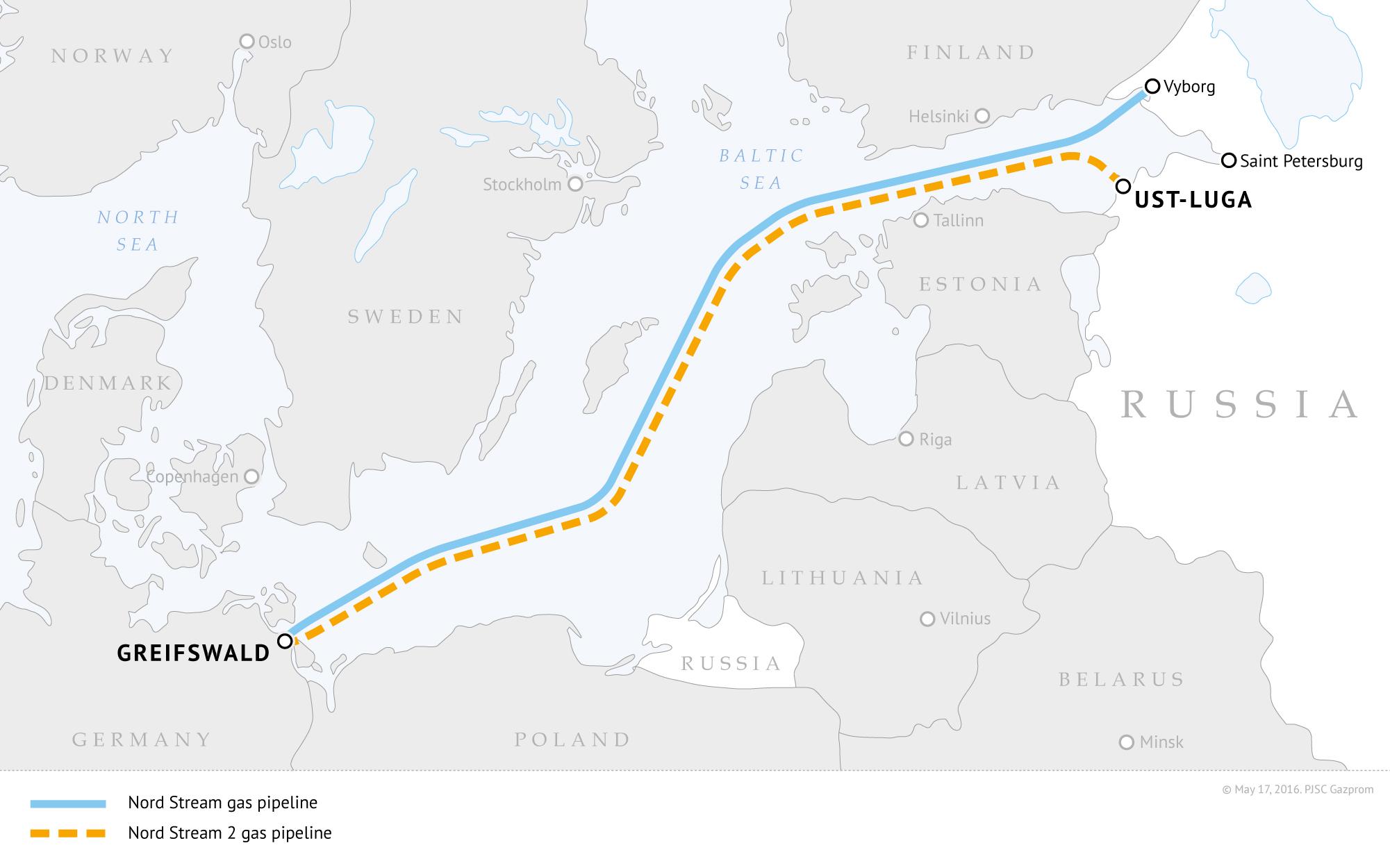
Another major issue is the US opposition to the Nord Stream 2 oil pipeline project with the Russian company Gazprom. This map from Gazprom's current English-language website on the project shows its planned route:
Münchau calls Nord Stream 2 "a sordid gas pipeline deal," though in his column it's not entirely clear what he finds sordid about it. The US opposes it for a variety of reasons, including its potential to increase European dependence of Russian oil and therefore makes the EU more vulnerable to Russian pressure by withholding oil, as Russia has done with Ukraine. The US also has outstanding disputes with Russia over Ukraine and election interference, in particular.
Germany views it as a profitable project for German firms and a contribution to energy stability, which is a major feature of EU energy policy. There are objections from environmental groups to the project. And eastern European countries, notably including Poland, are also opposed to it because of fear of increased Russian influence. On the other hand, it is also a fundamental idea of the EU that increased economic ties promote peace and make war less likely. Russia's economy is still heavily dependent on oil exports, as it has been since the 1970s under the Soviet Union. So Russia sees both profit and potential political clout in the deal.
Kirsten Westphal in the German energy-industry journal e.m.w Energie.Markt.Wettbewerb Oct 2016 describes the geopolitical considerations for the EU as follows (my translation from the German):
Nord Stream 2 and the future of Ukrainian transit [of oil] are symbolically highly charged in the political debate. Not only does it make it difficult to work on their policies, it is also driving EU energy policy in a difficult, if not dangerous, direction.
The dispute over Nord Stream 2 reveals dilemmas and discrepancies in the EU: In the EU-28, there is a general debate about how the future with Russia - including in energy relations - should be shaped. This is also true of the trilateral relations with Russia and Ukraine. Above all, however, there is disagreement among the EU-28 as to the shape of the [European] Energy Union and the Union's climate policy. This applies not only to the ambitions and objectives of climate protection, decarbonization and energy efficiency, as well as burden-sharing. The consensus on principles and guiding models seems increasingly fragile as some [EU] Member States are moving from a liberal energy market model to a state-interventionist, mercantilist energy policy. This increases political uncertainties and legal uncertainties. A reversion to a reliable legal framework, competition and the further development of the internal market are needed.
Münchau warns that Europeans should not assume that transatlantic trade relations will necessarily improve under a Democratic administration:
Europeans tend to associate the deterioration in the bilateral US-EU relationship with Mr Trump personally. But whatever tariffs, duties or sanctions Mr Trump might impose on Europe, most are likely to survive even if he is not re-elected. And, if he does remain in the White House, it is reasonable to expect the relationship to deteriorate further. So no matter what happens, the damage to the transatlantic alliance will persist.
If the pandemic had been a truly symmetric global shock, the story of deteriorating trade relations might have taken another turn. Countries would have had a greater incentive to align their policies. But the US may well come out of the slump faster than the EU — just as it did after the global financial crisis. Despite a higher number of cases and coronavirus-related deaths, it has a more robust economy and is less dependent on global supply chains than Europe. [my emphasis]